To start a career as a Business Development Representative (BDR), you must assume you’re already one.
In our newsletter, we’ll explain how the BDR role parallels the job search journey. First, let’s define and set expectations for a BDR role.
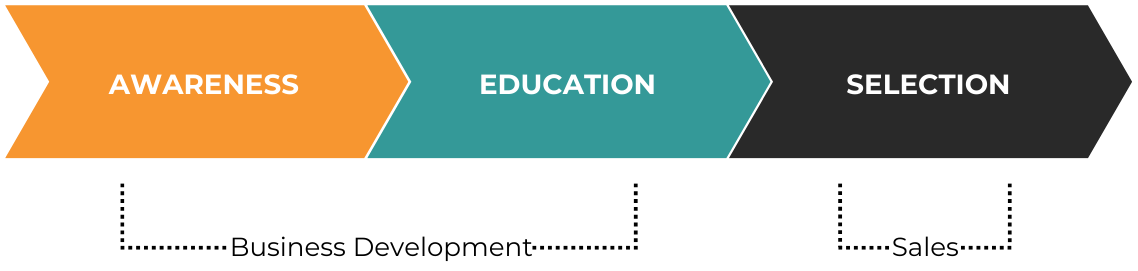
A Business Development Representative (BDR) is the person within the sales team who identifies new business opportunities.
Business Development Representatives DO NOT close deals and are instead responsible for:
- Identifying and chasing new leads
- Qualifying those leads
- Setting meetings between sales reps (such as an account executive) and new leads
Account executives and other sales reps are responsible for actually closing business. As a BDR, you are essentially the company’s front line—responsible for sparking interest in people who probably don’t even know they need your company’s solutions.
BDRs generate interest from potential buyers through prospecting and research, lead generation, cold calling and emailing, networking, and social selling.

Identify what makes you unique and define yourself as a Business Development Representative.
One of the first things you’ll learn at re:WORK is that the job search is a sales process — and your brand is what you’re “selling” to employers.
The principles you’ll use during your job search are the same as those of a BDR.
These tactics will not only help you find—and attract—future employers, but they are also the building blocks of social selling, a methodology top BDRs use to generate quality leads.
To start building your selling muscles, the two main methods you’ll use to develop your brand and run an effective job search are:
-
-
- Grow a professional network and share engaging content on LinkedIn
- Research job leads and conduct informational interviews with connections in your network
-

Social selling involves using social media platforms to connect, engage, and develop relationships with potential customers—or, in this case, potential employers.
Prospecting potential customers—in other words, researching to identify who fits the right criteria and will find value in your product or services—is the same way you will prospect new potential jobs. To prospect potential jobs effectively, you first have to do a little self-discovery.
What to consider:
- What am I looking for in a role?
- What salary am I aiming for, and what benefits are important?
- How far am I willing to commute?
- How do I want to be managed?
- How do I prefer to work? Alone or on a team?
- What do I value, and what kind of company culture best aligns with me?
- What size company do I want to work for?
- What skills do I want to develop, and what experiences do I want to gain in the next 1, 3, and 5 years?
- What are my career goals for the next few years, and what are the steps to get there?
- Are promotional opportunities and progression important to me in a new role?
- What is my USP, or “unique selling proposition,” and how do I communicate my strengths via social media content, informational interviews, and ultimately, the real interview process.

Mindset and Approach:
- BDR: As a BDR, you approach potential leads proactively, seeking opportunities and making connections.
- Job Search: Similarly, in your job search, you adopt a proactive approach by networking, researching potential employers, and reaching out to create opportunities.
Identifying Opportunities:
- BDR: BDRs identify new business opportunities by researching industries, understanding market trends, and targeting potential clients.
- Job Search: Job seekers identify career opportunities by researching companies, understanding job market trends, and targeting positions that align with their skills and goals.
Qualifying Leads and Positions:
- BDR: BDRs qualify leads by assessing their needs, budget, and fit for the company’s solutions.
- Job Search: Job seekers qualify for positions by assessing job descriptions, company culture, career growth opportunities, and alignment with their values and goals.
Engagement and Networking:
- BDR: BDRs engage with potential clients through networking, cold calling, emailing, and social selling to build relationships and generate interest.
- Job Search: Job seekers engage with potential employers through networking, informational interviews, job applications, and showcasing their skills and experiences to attract interest.
Building a Personal Brand:
- BDR: BDRs develop their brand by highlighting their unique value proposition, expertise, and success stories to attract prospects.
- Job Search: Job seekers build their brand by showcasing their skills, accomplishments, and professional reputation through resumes, LinkedIn profiles, portfolios, and interview presentations.
Closing Deals and Securing Offers:
- BDR: BDRs facilitate meetings and hand off qualified leads to sales reps for closing deals and securing new business.
- Job Search: Job seekers secure job offers by participating in interviews, demonstrating their fit and value to employers, and negotiating terms to close the deal.
If the process sounds intimidating or you’re scratching your head, don’t worry. re:WORK TRAINING will support you through this journey. Apply to our program today.
Share & join our LinkedIn Newsletter for details on how to #GetThisWork.